MBTA Communities Law
The MBTA Communities Law, enacted in 2021 (as Section 3A of Chapter 40A), is a zoning reform measure with the primary goal of addressing Massachusetts' severe housing shortage by fostering the creation of more multi-family housing, particularly near transit. It is a zoning reform measure rather than a direct affordable housing subsidy program. Its main goal is to increase the overall housing supply, particularly multi-family housing, in areas served by the MBTA.
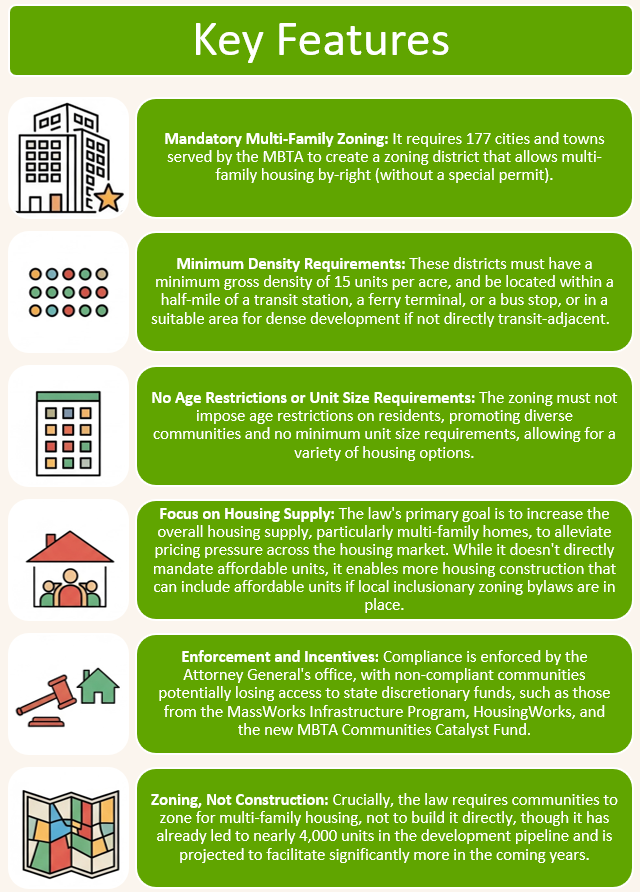
The MBTA Communities Law does not inherently mandate or directly subsidize affordable units in any category. Instead, it requires communities to create zoning districts where multi-family housing is allowed as of right (without needing special permits).
While the law itself doesn't set income restrictions for the new units, it is intended to create more market-rate and "missing middle" housing. By increasing the overall supply of housing, it will exert downward pressure on prices across the board, potentially creating more naturally occurring affordability over time.
The MBTA Communities Law aims to foster denser, transit-oriented development to combat the overall housing shortage and promote smart growth. It's about enabling housing production through zoning, rather than directly funding or dictating the income levels of residents in most new units.
Impact
The MBTA Communities Law mandates zoning capacity, not actual construction. It requires communities to zone for a certain number of units that could be built, given the minimum density requirements (e.g., 15 units per acre). This "unit capacity" is often much higher than what will actually be built, as it assumes full build-out of all developable land within the designated districts. While the law aims to facilitate hundreds of thousands of potential units in the long term (based on zoned capacity), actual construction depends on market forces, interest rates, construction costs, and developer willingness. Experts like those at Boston Indicators estimate that a "positive optimistic scenario" might yield 40,000 new housing units in 10 years directly attributable to the MBTA Communities Law, which would be a substantial contribution to the state's housing needs.
Its actual impact is still evolving, but key trends and initial outcomes are becoming clear.
-
The most significant impact to date has been the widespread adoption of compliant multi-family zoning bylaws by municipalities. As of late May 2025, 75% of the 177 communities subject to the law (133 cities and towns) have approved multi-family zoning districts. This is a monumental shift in zoning policy across the state, fundamentally changing what can be built by right in transit-served areas. The Supreme Judicial Court's ruling in January 2025 affirming the law's constitutionality and the Attorney General's power to enforce it has further pushed communities towards compliance.
-
While the law mandates zoning for multi-family housing, not necessarily the construction of it, in a May 30, 2025 press release, the state reports that more than 4,000 new housing units are already in the pipeline or being built under MBTA Communities zoning. This is a crucial early indicator that the zoning changes are indeed enabling development where it was previously restricted.
-
The law has undeniably forced a statewide conversation about housing supply, exclusionary zoning, and the need for more housing diversity. It has led to extensive public engagement, though often contentious, in many communities as they grapple with the implications of the new zoning.
-
The Healey-Driscoll Administration has linked compliance with eligibility for certain state grants, such as the new MBTA Communities Catalyst Fund, as well as existing MassWorks and HousingWorks programs. This provides financial incentives for communities to comply and helps fund necessary infrastructure improvements to support new housing.